Twenty Months That Rewrote Federal AI Buying, Seen From VA
Between January 2025 and September 2026 the federal government issued six AI executive orders, five OMB AI memoranda, an AI Action Plan, the OneGov AI agreements and the first proposed contract clause written specifically for LLMs. The six years before that produced three orders and one memo. VA is the agency where the stack lands hardest: a public AI inventory that grew nine-fold in two years, most of it high-impact, and three solicitations in one summer that describe a single strategy.
Anyone selling AI into a federal agency in 2026 is selling into a rulebook that did not exist twenty months ago. The rules arrived faster than the market’s reading of them, and they arrived as contract terms rather than as policy. VA is the clearest place to watch it happen, because VA publishes more about its AI than any other department and because it bought more of it, faster, this summer.
The stack, in two panels
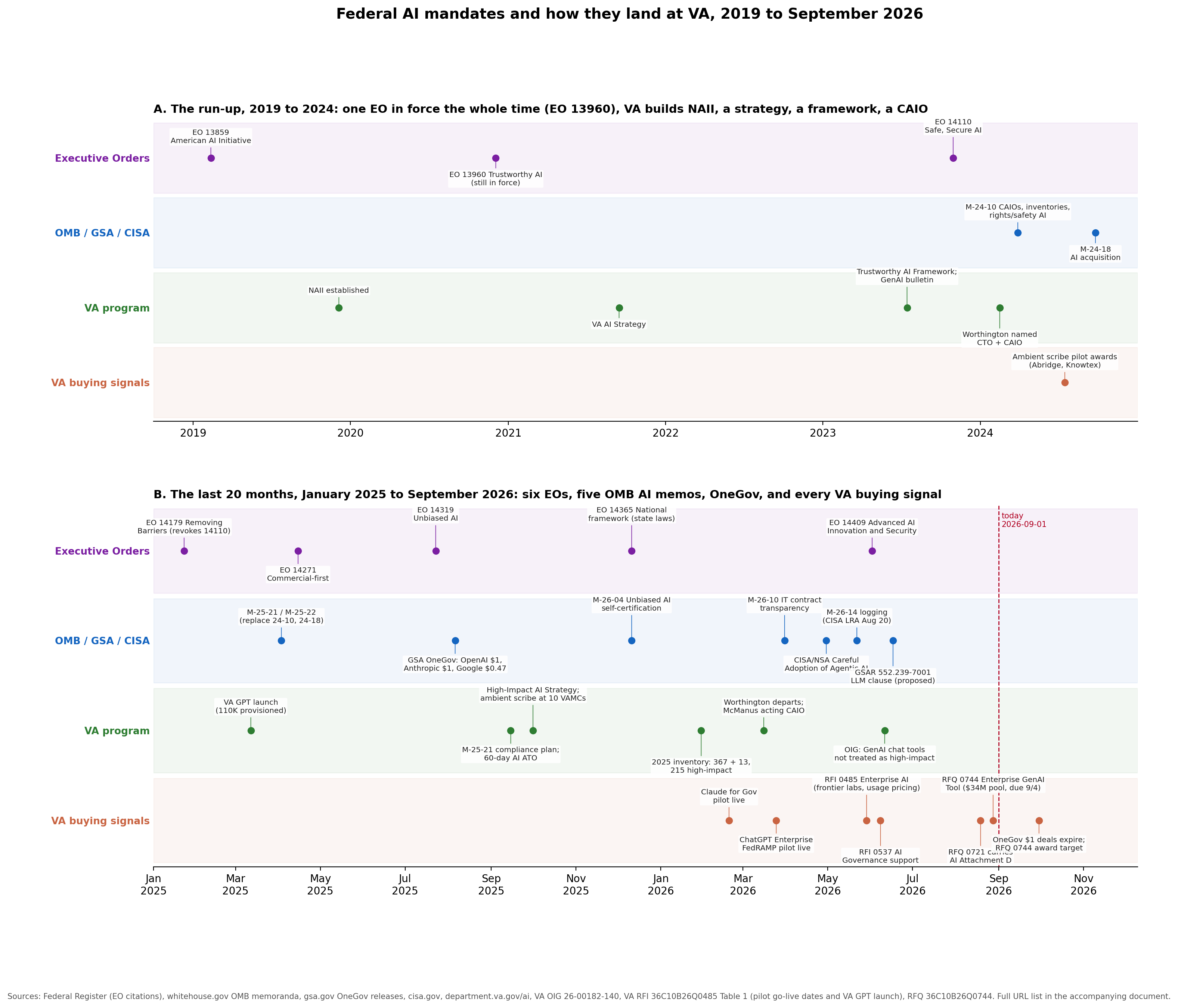
The top panel is the run-up. One executive order stayed in force the whole time: EO 13960 of December 2020, which set trustworthy-AI principles for federal use and required annual public use-case inventories. VA built its National Artificial Intelligence Institute (2019), an AI strategy (2021), a Trustworthy AI Framework with six principles (2023), and a Chief AI Officer (2024) on that foundation. OMB’s M-24-10 (March 2024) added the machinery: governance boards, rights- and safety-impacting designations, minimum practices.
The bottom panel is the last twenty months. EO 14179 (January 2025) revoked the 2023 order and directed an AI Action Plan. M-25-21 and M-25-22 (April 2025) replaced the 2024 memos, kept the CAIO, the governance board and the public inventory, renamed the risk tier “high-impact,” and barred training commercial models on government data without authorization. EO 14319 (July 2025) added two Unbiased AI Principles for procured language models, and M-26-04 (December 2025) turned them into a vendor self-certification and a transparency documentation package. GSA signed OneGov agreements that put three frontier vendors’ products into agencies for a dollar or less. M-26-10 (March 2026) made IT contract pricing and utilization reportable. CISA and NSA published the first multi-nation guidance on agentic AI services (April 2026). M-26-14 (May 2026) rewrote logging requirements, and CISA’s Logging Reference Architecture (August 2026) wrote human review points into them. EO 14409 (June 2026) directed AI-enabled cyber defenses. GSA proposed the first contract clause written for LLMs (June 2026).
How it lands in a solicitation
The test of a mandate is whether it shows up in a Section C clause. At VA, all of it does. A current VA IT solicitation with AI in scope now carries: a proposal-stage self-certification of truth-seeking and ideological neutrality, with omission grounds for rejection (EO 14319, M-26-04); a documentation package covering acceptable use, model and system cards, pre- and post-training disclosures including foreign development, bias evaluations and enterprise controls (M-26-04’s transparency documentation); a signed attestation against VA’s six AI principles, re-signed annually, as a material term (EO 13960 and the VA framework); a list of all AI for Contracting Officer approval before use, feeding the public inventory (M-25-21); no training on agency data, no offshore processing, unlimited government rights in models and outputs (M-25-22, FAR 52.227-14, the SHARE IT Act); a compliance monitoring plan, corrective action within ten business days, and thirty days’ notice before any material model change (M-26-04’s monitoring and remedies); and, where the buy is an agentic platform, approval gates by default, sandbox egress restrictions, sub-agents that inherit their parent’s permissions and logging, tamper-evident audit records and an audit-event API (CISA’s agentic guidance and the logging architecture, rendered as capability requirements).
That last group is the doctrine in contract form. Approval gates and a Contracting Officer’s unilateral right to deactivate any AI are Law 5, humans retain the right to intervene. Tamper-evident audit and event-level retrieval are Plane 4. A rollout that provisions everyone but expands agentic use wave by wave is the maturity model’s operative rule: never deploy agents beyond your current governance maturity.
What VA’s inventory actually contains
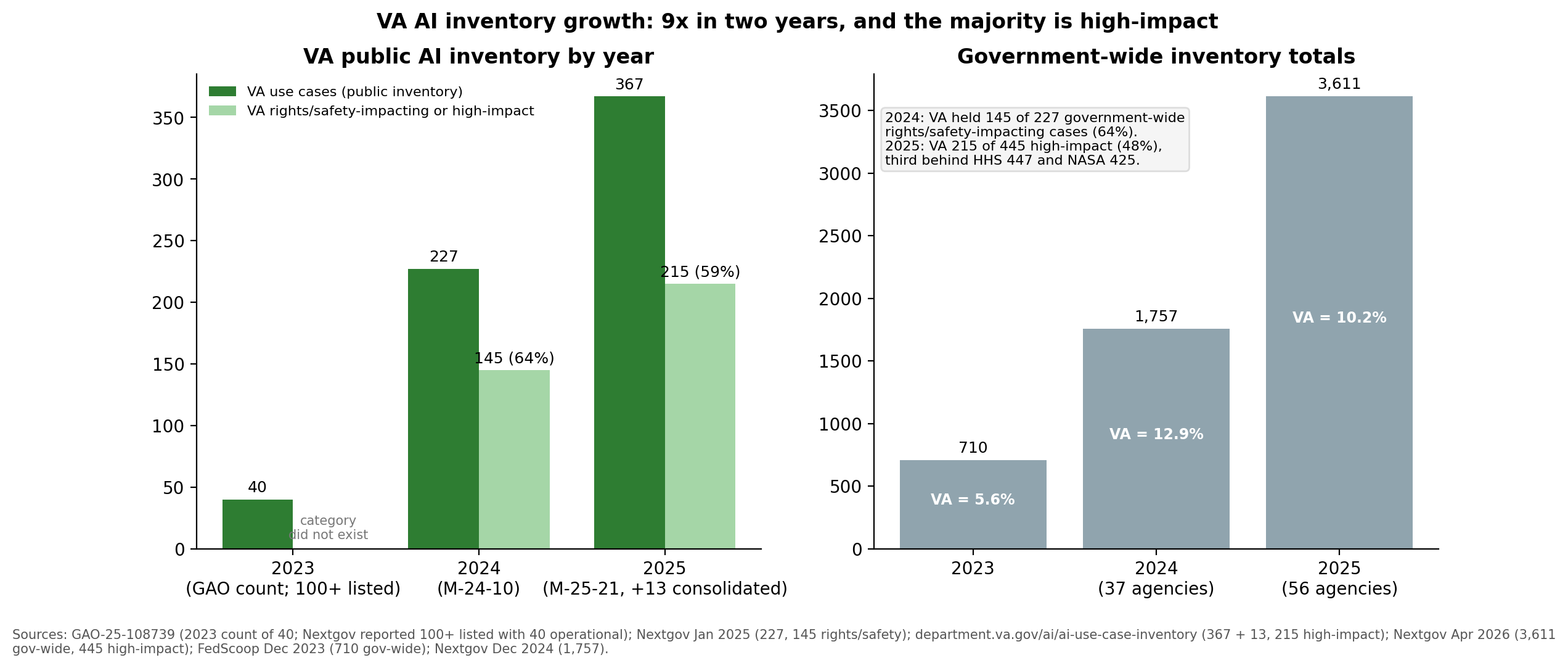
VA’s public inventory counted 40 use cases in 2023 (GAO’s count; VA listed more than 100 with 40 operational), 227 in 2024, and 367 individual plus 13 consolidated in 2025. In 2024 VA held 145 of the 227 rights- or safety-impacting use cases reported government-wide, 64 percent. In 2025 it held 215 of 445 high-impact cases, 48 percent, third in total count behind HHS and NASA and first in consequence.
The 2025 inventory decomposes into a deployed base and a pipeline. The deployed base is computer vision and classical machine learning inside VHA: 134 deployed use cases, 90 of them high-impact, most of them clinical devices and imaging. The pipeline is generative and agentic: 55 rows classified as generative AI and 25 as agentic AI, of which eight generative and three agentic are deployed; 39 generative and 22 agentic sit in pre-deployment. For the 90 high-impact deployed cases, the public page reports 100 percent completion on pre-deployment testing, impact assessment, independent review, ongoing monitoring and operator training, 96 percent on fail-safes and 88 percent on appeal processes.
Read that alongside the Inspector General’s June 2026 report. VA GPT, the in-house tool with about 100,000 users, and Copilot Chat, with about 74,000 monthly users, were never designated high-impact despite clinical use, because, in the OIG’s words, “VA leaders’ emphasis on reducing barriers to innovation influenced oversight decisions.” VHA had no formal process to report, track or resolve generative AI safety events. The largest deployments by user count were outside the pipeline the inventory describes. VA concurred with all three recommendations.
Three solicitations, one strategy
In late May 2026 VA issued a market-research notice for enterprise AI that said it “intends to establish the most direct contractual relationships possible with Frontier AI Labs,” wanted “exclusively usage-based” pricing across every surface with most-favored-customer benchmarking and quarterly downward adjustment, and framed its roadmap as a progression from assistive to collaborative to agentic use for three personas: an oncology clinician, a housing services manager, and an engineer. The notice disclosed its own adoption numbers: a legacy in-house chat tool at 35,000 monthly actives; a Microsoft assistant at 74,000; two frontier-lab pilots at roughly 11,000 and 3,000 monthly actives; a third at twenty users on public data only. In June VA issued a second notice for a contractor to run the Chief AI Officer’s governance operation: use-case intake and review, an auditable inventory, LLM-enabled governance tooling, and a transition to a federated model across administrations. In late August VA issued the platform solicitation itself: a first-party enterprise AI product only, a 144-item capability matrix, twelve named benchmarks, consumption credits rather than seats, a rollout to the whole workforce with agentic users targeted at three-quarters of chat users, and a live 48-hour challenge on real VA data after close.
The consultative reading is short. VA has decided to become an AI operating environment. It has the mandate stack to justify it. It does not yet have the governance throughput to review what the platform will generate, or the workforce depth to absorb it: GAO found in July 2026 a “severe shortage of federal staff with AI expertise,” the Chief AI Officer who wrote the strategy left in March, and the enablement services in the platform requirement are, in effect, VA’s AI workforce for the base year.
What VA is not asking for, and should be
An evaluation harness of its own, with agency data, so that a vendor’s thirty-day model change disclosure is reviewed against something other than the vendor’s model card. A clinical generative-AI incident pathway that connects the contractor’s compliance monitoring plan to the National Center for Patient Safety, which is exactly the gap the OIG named. A tiering test for agentic use cases, since M-25-21’s high-impact test asks whether an output is a principal basis for a decision and never asks whether the AI took an action. A single identity and retention model across the five products its workforce already uses. And exit economics for hundreds of thousands of users’ working context when a base year ends and the OneGov promotions have already expired.
What to watch
The OneGov AI agreements expire September 30, 2026, the same day VA’s platform award is targeted. Agency logging plans are due to OMB and CISA on November 18. The 2026 inventories are due in December, the first that will contain an enterprise agentic platform and the first where the agentic classification will matter. GSA’s LLM clause is proposed, not final. Each of those changes a row in the table above.
Primary sources
- EO 13960, Promoting the Use of Trustworthy AI in the Federal Government (Dec 2020) ↗
- EO 14179, Removing Barriers to American Leadership in AI (Jan 2025) ↗
- OMB M-25-21, Accelerating Federal Use of AI (Apr 2025) ↗
- OMB M-25-22, Driving Efficient Acquisition of AI (Apr 2025) ↗
- EO 14319, Preventing Woke AI in the Federal Government (Jul 2025) ↗
- OMB M-26-04, Increasing Public Trust in AI Through Unbiased AI Principles (Dec 2025) ↗
- OMB M-26-14, Agency Logging and Network Visibility (May 2026) ↗
- CISA, NSA and partners, Careful Adoption of Agentic AI Services (Apr 2026) ↗
- EO 14409, Promoting Advanced AI Innovation and Security (Jun 2026) ↗
- GSA, proposed GSAR 552.239-7001, Basic Safeguarding of Data within LLM AI Systems (Jun 2026) ↗
- VA AI Use Case Inventory (2025, updated April 2026) ↗
- VA Compliance Plan for OMB M-25-21 (Sept 2025) ↗
- VA OIG 26-00182-140, Review of Generative AI Chat Tools for Clinical Use (June 2026) ↗
- GAO-25-108739, Veterans Affairs: Key AI Practices Could Help Address Challenges (Sept 2025) ↗
- GAO-26-109137, VA Disability Benefits: Modernizing Technology and Adopting AI (July 2026) ↗
- Nextgov, agencies report over 3,000 AI use cases for 2025 (Apr 2026) ↗
- Nextgov, VA accounts for majority of rights- and safety-impacting AI (Jan 2025) ↗
- FedScoop, VA seeks information on AI interface and API services for its workforce (May 2026) ↗
Maps to the doctrine
This analysis draws on the independent Governed Autonomy Doctrine:
This briefing is original MissionHarness.ai analysis. Every factual claim above links to a primary source. Doctrine terms link to the independent standard at governedautonomy.org.